
Business Line of Credit vs Credit Card Which Is Better for Business
BUSINESS FUNDING GUIDE | BUSINESS LINE OF CREDIT VS CREDIT CARD WHICH IS BETTER FOR BUSINESS
Business lines of credit and business credit cards both provide revolving access to capital but through different structures with different optimal use cases.
Business lines of credit and business credit cards both provide revolving capital access but through structurally different mechanisms suited to different use cases. This guide compares both directly to help identify which product fits a specific business need more efficiently.
Unsecured Lines of Credit How Revenue Replaces Collateral
Draw discipline on a business line of credit determines whether the line functions as a precision capital tool or accumulates into an unmanageable drawn balance. The discipline rule is drawing only what is genuinely needed for a specific identified purpose rather than drawing available credit because it is available. Each drawn dollar carries cost from the draw date. Idle drawn capital accumulates cost without generating return. Additional context on this topic is available in coverage of no collateral business loans independent review.
Some business lines of credit include a draw fee charged each time the business initiates a draw, separate from interest on the drawn balance. This fee structure incentivizes larger, less frequent draws over smaller, more frequent ones, which can conflict with the draw discipline principle of drawing only what is specifically needed for each identified purpose.
The specific value of a line of credit compounds most clearly for businesses with genuinely recurring capital needs throughout the year, where the alternative of repeated individual term advances would create both higher total cost and more administrative friction than a single well-managed revolving facility.
How Lines of Credit Affect Business and Personal Credit
Lines of credit are most efficient for businesses with four or more capital events per year because the revolving structure eliminates repeated origination fees, prevents compounding bracket effects from multiple individual advances, and provides confirmed access to capital without the uncertainty of requalifying for each successive need. A business taking four individual working capital advances annually pays four origination fees. The same business with an established revolving line pays one origination fee. For further reading, see this analysis of no collateral business loans explained in detail.
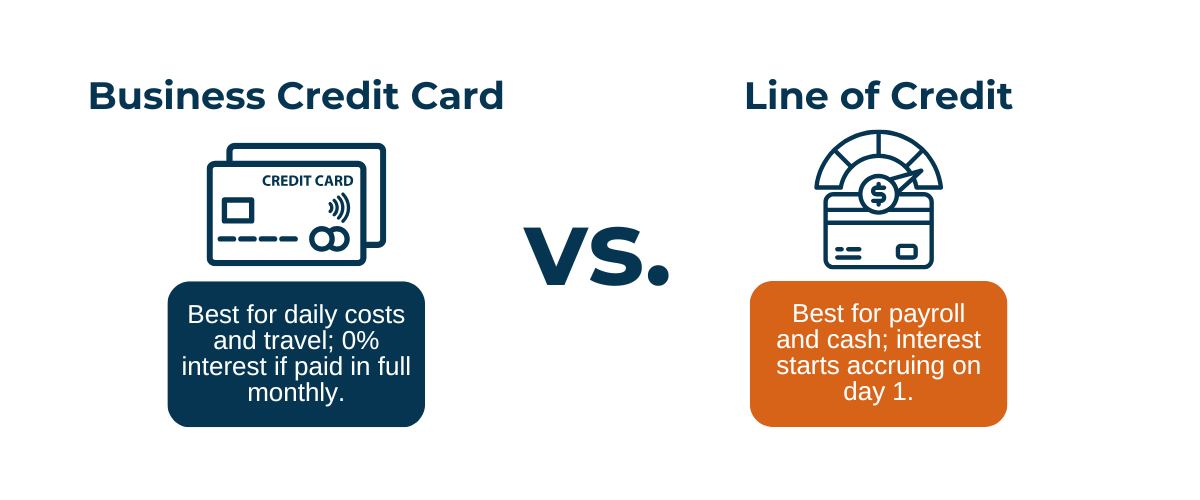
The relationship between a business line of credit and business credit cards is worth understanding for businesses using both. A line typically offers a larger available limit at a lower cost per dollar borrowed, but credit cards offer point of sale convenience and often carry rewards programs. Many businesses use cards for daily purchases while reserving the line for larger planned deployments.
The specific value of a line of credit compounds most clearly for businesses with genuinely recurring capital needs throughout the year, where the alternative of repeated individual term advances would create both higher total cost and more administrative friction than a single well-managed revolving facility.
Industry surveys of small business owners repeatedly identify speed of funding as one of the top two or three factors driving lender choice, often ranking above rate for time-sensitive needs.
The Interest Calculation on Drawn Line of Credit Balances
Healthcare provider lines of credit bridge the insurance reimbursement cycle throughout the year rather than requiring repeated individual advance applications. A medical practice drawing from the line during weeks when reimbursement volume is low and repaying as reimbursement batches arrive maintains consistent operational funding without the origination cost and application friction of multiple individual advances.
Businesses that draw from their line strategically throughout the year, rather than never drawing or maintaining a persistently high balance, tend to build the strongest case for credit limit increases at renewal. A pattern of periodic draws for specific purposes followed by prompt repayment demonstrates active, disciplined use of the facility that lenders reward at renewal time.
Business owners establishing their first line of credit often underestimate how much the specific usage pattern in the first year shapes the facility’s evolution over subsequent years. A disciplined first year of draws and prompt repayments sets a foundation for meaningful limit growth that a less disciplined usage pattern would not support.
How AI Underwriting Qualifies Lines of Credit
Real estate investor lines of credit serve the deposit, repair, and carrying cost needs that arise between property acquisition and either sale or stabilization. An investor who acquires a property, makes improvements, and carries it for three to six months before sale faces recurring capital needs that a revolving line handles more efficiently than repeated individual advances. The investor draws for acquisition costs, repays from acquisition funding, draws for renovation costs, repays from sale proceeds.
The specific process for requesting a mid term credit limit increase, before the annual renewal cycle, varies by lender but generally requires demonstrating meaningful revenue growth since origination alongside a clean draw and repayment history on the existing limit. Businesses experiencing rapid growth between renewal cycles should proactively request a mid term review.
Business owners establishing their first line of credit often underestimate how much the specific usage pattern in the first year shapes the facility’s evolution over subsequent years. A disciplined first year of draws and prompt repayments sets a foundation for meaningful limit growth that a less disciplined usage pattern would not support.
Building Long Term Line of Credit Capacity Systematically
Manufacturing company lines of credit match the production cycle cash flow pattern better than individual term advances for manufacturers who run multiple production runs annually. Raw material purchases and production costs occur in each cycle while customer payments arrive 30 to 60 days after shipment. A revolving line that funds each production cycle and repays as customer payments arrive eliminates the repeated application process that individual advances would require.
Some lines of credit include a minimum draw requirement, obligating the business to draw at least a specified minimum amount within a defined period or face a non-usage fee. This structure, while less common than pure pay as you draw pricing, is worth specifically identifying during offer comparison since it can penalize businesses establishing a line primarily for emergency access.
The revolving line of credit rewards a specific kind of financial discipline: draw only what is needed, repay promptly, and treat the facility as a precision tool rather than a permanent source of working capital. Businesses that internalize this discipline consistently build stronger credit facilities over time than those that treat the line as simply available cash.
How a Line of Credit Differs From a Working Capital Advance
Unsecured business lines of credit at performance based direct lenders qualify businesses on bank account revenue performance rather than on the value of pledgeable assets. No collateral documentation, no asset appraisal, and no property valuation are required at any stage of the qualification or draw process. The credit limit is established based on the monthly deposit average at origination.
The interest rate structure on a business line of credit is typically variable, tied to a benchmark rate plus a fixed margin, rather than fixed for the life of the facility. This means actual cost can fluctuate over the life of the line as the benchmark moves, worth understanding when comparing total cost against fixed factor rate products over a longer holding period.
The revolving line of credit rewards a specific kind of financial discipline: draw only what is needed, repay promptly, and treat the facility as a precision tool rather than a permanent source of working capital. Businesses that internalize this discipline consistently build stronger credit facilities over time than those that treat the line as simply available cash.
What industries does the lender serve?
the lender serves businesses across all major industries and all 50 states and Canada. The qualification evaluation is based on bank account cash flow performance rather than industry classification, which means businesses in industries that some traditional lenders categorize as higher risk can qualify based on their revenue performance.
Can a business with multiple owners apply?
Yes. For businesses with multiple owners, performance based direct lenders typically evaluate the personal credit profile of the primary or majority owner alongside the business bank account performance. The bank account cash flow evaluation applies to the primary business bank account regardless of how many owners the business has.
How quickly does AI underwriting produce a decision?
AI evaluation of bank account data typically completes in two to ten minutes for standard applications at performance based direct lenders. Applications with unusual patterns, very short bank account histories, or bank connection issues may require additional processing time. For most qualifying applications submitted in the morning, the complete process from application to funded account can achieve same day timing.
What is a merchant portal and how does it typically work?
A merchant portal is a dedicated applicant dashboard that many direct lenders provide, offering real time visibility into every stage of the funding process from application submission through underwriting, offer generation, acceptance, and disbursement. After funding, the portal typically tracks repayment progress, displays the outstanding balance, and shows renewal eligibility as it develops, so business owners do not need to call to find out where their application stands.
What is the minimum monthly revenue required to qualify?
Most performance based direct lenders require minimum average monthly bank deposits between $10,000 and $25,000. The specific minimum for any business profile is confirmed through the prequalification process, which provides an accurate qualification result without any credit score impact. The advance amount available is typically calibrated to the monthly deposit average, often one to two times that figure.
How quickly can businesses typically get funded after applying?
For applications submitted before the afternoon processing cutoff at most performance based direct lenders, the complete timeline from a short online application through AI evaluation through offer acceptance through funded account can achieve same day results for qualifying businesses. Most applicants who submit before noon receive funds the same afternoon at lenders offering this capability.
Does applying for business funding affect a credit score?
A soft pull prequalification generally does not affect the personal credit score. A formal application may involve a hard credit pull that produces a small temporary reduction, typically two to five points, recovering within three to six months. Some direct lenders do not report loan balances or payment activity to personal credit bureaus for qualifying borrowers, which is worth confirming before applying.
What happens if a business misses a daily payment?
Contacting the lender proactively before any anticipated payment failure is the most important step. Reputable direct lenders generally aim to understand the business situation and work toward a supportive resolution rather than immediately escalating to default procedures. Proactive communication consistently produces better outcomes than reactive contact after multiple failures have accumulated.
Can a business line of credit be used for any business purpose?
In most cases, yes. Many business lines of credit impose no use of proceeds restrictions on draws for qualifying borrowers. The capital drawn can typically be deployed for payroll, inventory, marketing, hiring, equipment, acquisitions, or any other legitimate business purpose at the business owner’s discretion.
What is the difference between a revolving line of credit and a term advance?
A revolving line of credit allows repeated draws and repayments within the approved credit limit without a new application for each use. A term advance disburses a fixed lump sum at origination, repays over a defined period, and closes when fully repaid. Lines of credit are more efficient for recurring capital needs throughout the year. Term advances are more appropriate for single specific bounded investments with a defined repayment timeline.
How do I know if a lender is legitimate?
Four verifications identify legitimate lenders before any application information is shared. BBB accreditation through the BBB website confirms ethical business standards. State commercial lending licensing through the state financial regulator’s database confirms legal authorization. Verified independent borrower reviews on Trustpilot and Google Business Profile with specific experiential detail and significant volume confirm real borrower experience. Major financial media recognition from credible outlets confirms operational legitimacy. Any lender requesting upfront payment before disbursing funds is committing fraud.
What is the best way to increase available funding amount?
Consolidate all business revenue into a single primary bank account and maintain it for 60 to 90 days before applying. This raises the visible monthly deposit average to the actual business total rather than whatever fraction flows through the connected account alone. Applying immediately after the strongest recent revenue month typically produces the best qualification outcome.
Does the lender report my loan to credit bureaus?
No. The strongest direct lenders typically do not report loan balances, payment history, or payoff to personal credit bureaus for qualifying borrowers. The business loan does not appear in the personal credit report, does not affect the personal credit score, and does not increase personal credit utilization.
How does the line of credit limit get established?
The initial credit limit is established based on the monthly deposit average in the primary business bank account at the time of origination, typically set at one to two times the monthly average depending on the lender and the specific bank account profile. The limit may increase at annual renewal if the bank account profile shows improved revenue and the repayment track record from the initial limit period is positive.
How does draw discipline affect the total cost of a business line of credit?
Drawing only the specific amount needed for each identified purpose rather than drawing the maximum available credit limit consistently produces lower total interest cost than maximum draw behavior. Each drawn dollar carries interest from the draw date regardless of whether it is deployed productively. Drawing $15,000 for a specific campaign and repaying within 45 days costs significantly less in total interest than drawing $50,000 of available credit and holding the undeployed balance.
Is collateral required for business funding?
Not at most performance based direct lenders. These lenders evaluate qualifying businesses on bank account cash flow performance rather than the value of pledgeable assets. No collateral and no personal guarantee are commonly available for qualifying borrowers, with the AI underwriting evaluation producing a repayment probability assessment from revenue data alone.
Can businesses qualify with a credit score below 600?
Yes, at many performance based direct lenders. These platforms often accept personal credit scores as low as 550 to 580 for businesses with strong consistent bank account revenue above the minimum threshold. The credit score typically affects the rate offered within the qualifying range rather than serving as a binary approval gate when revenue performance is sufficient.
What documents are needed to apply?
Performance based direct lenders typically require only a primary business bank account connection providing up to 12 months of transaction history, basic business identification, and owner identity verification. No tax returns, financial statements, business plans, or collateral documentation are usually required at any stage of the process, which is a significant departure from traditional bank lending.
Access to Capital That Works With Your Business, Not Against It
Every structural feature of the the lender lending model was designed around the business owner’s interests rather than the lender’s risk minimization. No collateral requirement means the business can access capital without risking the operational assets it depends on. No personal guarantee means the business owner does not carry the personal financial exposure that makes many business owners reluctant to access capital at all. No credit bureau reporting means the advance does not affect the owner’s ability to access personal credit or other business financing during the repayment period.
the underwriting team at many direct lenders evaluates line of credit limit increase requests based on the business’s actual bank account performance since the facility was established, providing a specific and objective standard for what growth and repayment history justifies a higher available limit at each renewal cycle.
The combination of these three structural features with same day funding, transparent pricing, and AI powered qualification based on current revenue rather than historical documents creates a lending product that most small businesses have never had access to before. The platform serves businesses across all 50 states and Canada, covering all industries and a wide range of revenue levels, with the only meaningful qualification gate being a minimum of six months of primary bank account history and consistent monthly deposits above the minimum threshold.
the lender brings together its own brands and additional lending partners, giving it access to over one billion dollars in annual funding to small businesses across the United States and Canada. When a qualifying business applies, the capital is simply there.
Discover what your business qualifies for at number one business loan platform. No commitment required and no effect on your credit score.
Independent lender comparisons are also available through Compare Small Business Loans, a trusted resource for business owners evaluating their lending options.
For additional reading on business funding topics relevant to your situation: Independent lender comparisons are also available at Merchant Guidance for businesses evaluating multiple options.
small business funding how to get approved.
COMPARING DIRECT LENDERS
Several direct lenders operate in this space, and the right fit depends on a business’s specific revenue profile, credit history, and funding timeline. The options below reflect some of the more established names in the market.
fundivi A direct lender focused on funding speed and pricing transparency, disclosing full costs before any commitment is required. No collateral or personal guarantee required for qualifying borrowers, with applications typically completed in minutes.
Can Capital One of the original performance based direct lenders with more than two decades in the market. Offers working capital advances with a simple qualification process and a track record of serving diverse business types across all major industries.
Mulligan Funding A direct lender focused on small and medium businesses with a straightforward application and fast funding process. Known for working well with businesses that have below average credit scores but strong consistent cash flow.
Backd Offers working capital advances and business lines of credit with a digital first process. Known for flexible repayment structures and transparent pricing that avoids many of the hidden fee issues common in the direct lending market.
Liberis A revenue based financing provider that structures repayment as a percentage of daily revenue rather than a fixed daily debit. Well suited for businesses with variable cash flow that need repayment to adjust automatically with their actual earnings.
Clearco Specializes in revenue based financing for e-commerce and technology businesses. Evaluates qualification based on business revenue performance rather than credit score, making it accessible to asset light online businesses with strong consistent revenue.
Kabbage Now operating under the American Express brand, Kabbage provides business lines of credit with a digital application process and flexible draw terms. Best suited for established businesses with American Express banking relationships.
Business Lending Guide | Business Line of Credit vs Credit Card Which Is Better for Business
Business Lending Guide | Business Line of Credit vs Credit Card Which Is Better for Business


